On this page
Is a voxel world flat or round?
Usually flat. Most voxel worlds are an endless grid of blocks that stops at a world border. Walk east forever and you never come back from the west: you hit the edge. That's why "voxel game with a round world" is such a popular search: people want the sphere, and what they usually find are tricks and shaders that bend the picture while the world underneath stays a flat grid.
Openworld was built the other way around. It's a voxel sandbox on a whole, round planet — walk straight and you come back to where you started — under a real sky with Moon phases and eclipses, all the way to the Sun, by way of the Moon and the planets. Not a mod, not a trick of the camera: the world itself is a globe, and every cube you dig or place sits somewhere on it.
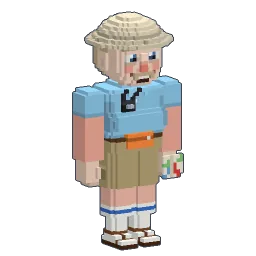
scroll to walk · drag to spin
A whole planet
1,000 km of radius. No edge anywhere.A flag marks the start. Our tourist sets off straight ahead.
Straight ahead
The ground curves away in front of you.Every step is on flat ground — the planet does the bending.
Day, then night
Day and night travel around the globe.Walk long enough and you cross the night side.
6,283 km
A little more than Paris to New York.That's the length of the equator — in the game, at real walking speed.
Back home
Same flag, same spot. You went all the way around.
And then
The Moon rises over the edge of the world.It's a place too. You can go there.
Can you walk around the whole world?
Yes. The planet is closed on itself, so any straight line eventually loops back. The numbers come straight from the game's code:
- 1,000 kmradius of the Earth
- 6,283 kmaround the equator
- 404 hto walk it, non-stop
- 25 minfor one day and night
You walk at 4.3 m/s and sprint at 5.6 m/s, so a lap takes about 404 hours on foot, or 311 hours sprinting the whole way (if your hunger lets you). With 25-minute days, that's nearly 1,000 in-game days (about 970): over two and a half years of game time for a single trip around.
And it isn't a straight dry road. On the way you'll meet seas you have to swim or go around, mountain chains, deserts and forests. The planet is 6.371 times smaller than the real Earth, which keeps it travelable, but it's still big: its surface is about 12.6 million km², more than all of Europe.
How do you put cubes on a sphere?
That's the puzzle every round voxel world has to solve: cubes like to be in a flat grid, and a sphere has no flat grid. Openworld's answer, in plain words:
- Inflate a cube into a ball. The planet is indexed like a cube with 6 faces, "inflated" until it's round. Each face is cut into 90,437 × 90,437 columns of 16 × 16 meters: about 49 billion columns for the whole Earth.
- Keep every cube the same size. A voxel is 25 cm everywhere — at the equator, at the poles, in the middle of an ocean. Nothing is stretched or squashed, so walls stay straight and builds stay square.
- Unroll the ground flat around you. Physics, collisions and building all happen on a flat local plane around the player, with "up" pointing away from the planet's center. Gravity always pulls you straight down, wherever you are.
- Turn smoothly at the seams. When you walk from one face of the cube to the next, the game turns your heading and your speed by the same angle, in one go. No loading screen, no visible jump: you just keep walking.
- Generate the land on the sphere itself. Mountains, rivers and biomes are computed from your real position on the globe, so there's no seam along the cube's edges. Temperature follows latitude and altitude: it's colder toward the poles and up in the mountains.
There's one honest quirk: at the 8 corners of the cube, three faces meet instead of four, so the grid there is missing a quarter turn. It's a known spot, handled by the game — on a planet this size, you'd have to go looking for it.
Why not bend the cubes instead?
Some round-world demos shrink the blocks as you go down, or deform them near the surface. That looks clever, but it breaks what makes a voxel game fun: a block should be a block. In Openworld you dig, build, place half slabs and lay out a perfectly straight wall exactly as you would on a flat map. The roundness only shows up at scale — over kilometers, not over your house.
What does the horizon look like?
Closer than you're used to. Your eyes are at 1.62 m, and on a planet of 1,000 km radius the sea horizon is only about 1.8 km away — on the real Earth it's about 4.5 km. Past it, things don't vanish, they sink: a building 10 km away loses its bottom 34 meters below the horizon, like a ship going down over the curve of the sea.
Beyond the blocks around you, the game draws far terrain out to as much as 10 km (4 km by default, set by Far distance in the options), laid on the sphere with its true curvature, fading into the color of the sky. Play with the numbers yourself:
Fly high enough and the planet becomes a ball
Climb above 1,012 m and the game stops loading blocks: what you see is the planet itself, a sphere painted with your world's real map — seas, ice, deserts, shaded relief — drawn from the same seed as the ground you walked on. Keep going (with a rocket, for instance) and the Earth shrinks into a blue-and-green ball hanging in space. Press M for the map: its Space view shows your planet in 3D, lit by the Sun, and you can turn it with the mouse.
Day and night on a round planet
Because the world is a globe that spins, the Sun doesn't simply switch on and off: it rises over one side of the planet while it sets on the other. A full day lasts 25 minutes. When it's noon where you stand, it's midnight for a friend on the opposite side of the world — a real time zone, with no special code behind it. A brand-new world even starts in the early morning, just after sunrise at your spawn point.
The Earth's axis is tilted by 23.44°, like ours. Over a year of 365 game days (about six days of real time), the Sun climbs higher or stays lower, and near the poles you get polar days when it never sets and polar nights when it never rises.
Then there's the Moon. It's 273 km in radius and orbits about 60,000 km away — the same proportions as the real Moon, so it looks the same size in your sky, about half a degree across. It goes through its phases, it sometimes passes in front of the Sun, and it's worth a guide of its own: the real sky above the planet, phases and eclipses.
Poles, continents and two kinds of worlds
Yes, there are poles, and nothing strange happens there: each pole sits in the middle of a cube face, where the grid is at its most regular. What you'll find is cold — pack ice, glaciers, snow — because temperature follows latitude.
When you create a world (Solo → Create a world), the Terrain line lets you pick between two layouts:
Scattered biomes
- The classic layout: lands of about 120 km
- Every kind of landscape close to your start
- Ideal for a first world
Giant continents
- A few continents of 1,000 to 3,000 km
- Real oceans between them, about a third of land
- You have to travel to find everything
Either way, the planet is seeded with giant ore lodes — 40 to 120 m wide, some of them with an old shored-up mine leading down. A couple of each common kind sit within a few kilometers of where you start; the others are spread around the globe, far apart from each other. Geography matters: the round planet gives you a reason to go and see what's over there.
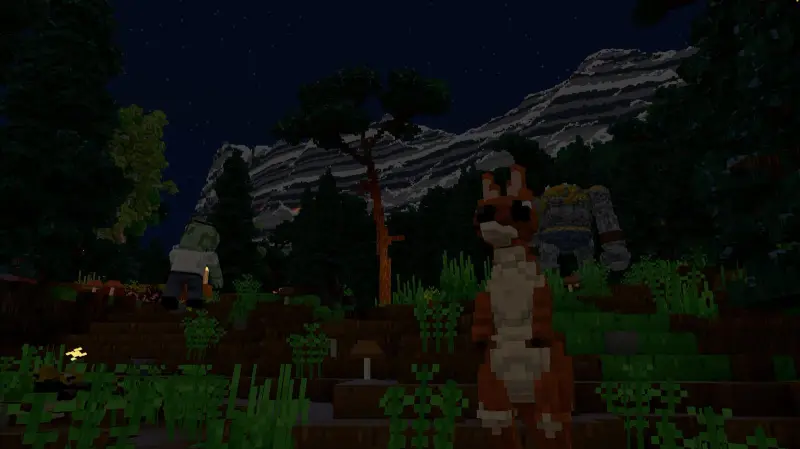
What a round planet changes when you play
- There's no edge. No world border, no void, no invisible wall: every horizon is a real place you can reach.
- Directions mean something. North and south lead toward the cold; the equator is where the days are most even; the far side of the world is genuinely far.
- Getting lost is real — so is getting home. Checkpoints, the map (M) and the compass on your HUD keep you oriented across a whole globe.
- Friends can be anywhere. On a server, the whole planet is shared: someone can build at the pole while you dig on the equator. More in playing with friends.
- Going up is a journey. Climb high enough and you see the curve; climb more and you can leave the planet for the Moon.
- Down is a journey too. Under every landscape there's rock, caves and lava — what's under the planet.
And if you'd rather see it from the air, jump off a cliff: Openworld is a wingsuit game too, and in a wingsuit or under a paraglider you fly over the planet and watch it roll by underneath.
Follow Openworld
@play_openworld is Openworld's official Instagram page: videos of the game and news of every update.
@play_openworldOpenworld is created by @tompascard
A round world is more than a camera trick: it comes with the rest of a game around the sphere. Survival, creatures, caves, building voxel by voxel, skins, multiplayer servers, a sky that works like the real one and a Moon you can stand on. If you're after voxel sandbox games with something genuinely new, the round planet is our answer.
Three steps to your own planet
- 1Install Openworld with the downloaded file: it sets up the launcher.
- 2Create your account in the launcher and confirm your email.
- 3Pick your username… and play.
Openworld is played on a computer: Mac, Windows or Linux. Send yourself the link, we'll be waiting on the other side.
Questions
Is Openworld's world really round?
Yes. The planet is a sphere of 1,000 km radius. Walk straight along the equator and you come back to your starting point after 6,283 km. There is no world border.
Can a voxel game have a round world?
Tricks and shaders can make a flat world look curved, but underneath it stays a flat grid that ends at a border. In Openworld the world itself is a globe.
How long does it take to walk around the planet?
About 404 hours at walking speed (4.3 m/s), or about 311 hours sprinting non-stop. With 25-minute days, that's nearly 1,000 in-game days. Seas and mountains are in the way, too.
Can you see the curvature of the planet?
Yes. Even from the ground the horizon is close, about 1.8 km at eye level, and distant things sink below it. Above 1,012 m the game shows the whole planet as a globe, and from space you see it as a ball.
Are there poles?
Yes, a north pole and a south pole. They're cold, with pack ice and glaciers, and the Earth's 23.44° tilt gives them polar days and polar nights.
How do I play Openworld?
Openworld runs on Mac (Apple Silicon and Intel), Windows and Linux. It's out now, in alpha: download it, create your account in the launcher and play. Download the game.