On this page
What's in Openworld's caves?
Openworld is a voxel sandbox on a whole, round planet — walk straight and you come back to where you started — under a real sky with Moon phases and eclipses. On Mac (native Apple Silicon), Windows and Linux. And under that planet, the ground is not a backdrop: the game carves a real cave network into the first 200 m under the surface, then dresses it according to depth and to the climate up above.
Three families of caves share the underground:
- Tunnels you can follow for minutes: 2 to 9 m wide, flat floors, forks, rooms where they meet, entrances that open in the ground — and ravines.
- Winding tubes 2.5 to 4 m across that climb and dive at every angle: the ramps and shafts between the levels of the network.
- Caverns: halls 10 to 60 m wide, 45 to 95 m down, with domed ceilings and stone pillars thick at their foot.
What you find inside depends on the land above you. Four cave climates:
- Dripstone caves (the most common): calcite stalactites, stalagmites under them, columns where they meet, gravel and clay floors. Under hot deserts, crusts of saltpetre.
- Lush caves (humid, mild land above): carpets of moss, curtains of vines, glowing mushrooms.
- Frozen caves (cold land above): ice floors and icicles of packed ice.
- Deep caves (from 68 m under sea level): basalt floors veined with magma rock, clusters of glowing crystals.
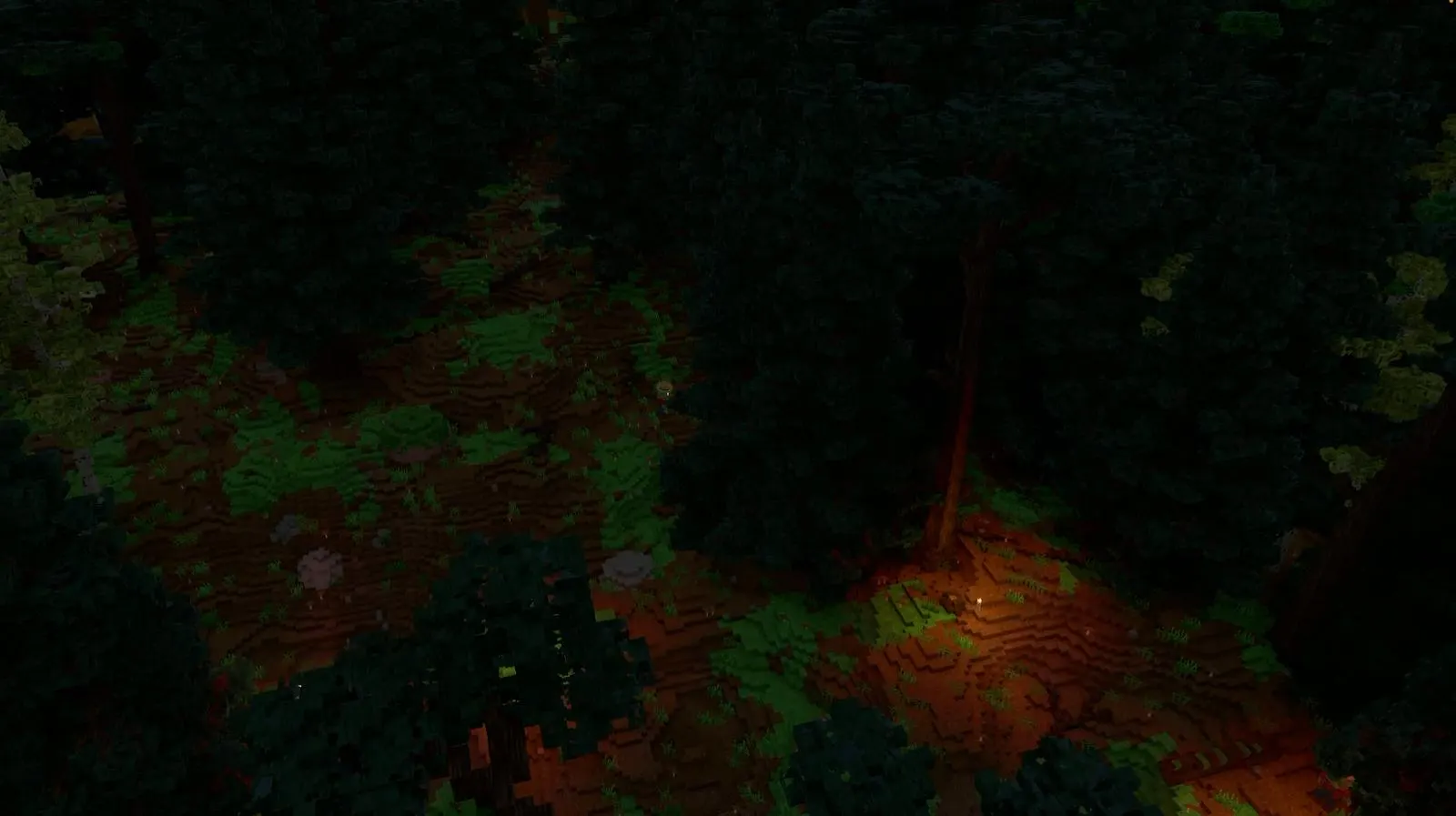
Under the grass
A few meters of soil, then rock — and already the dark specks of coal and pale grains of iron.
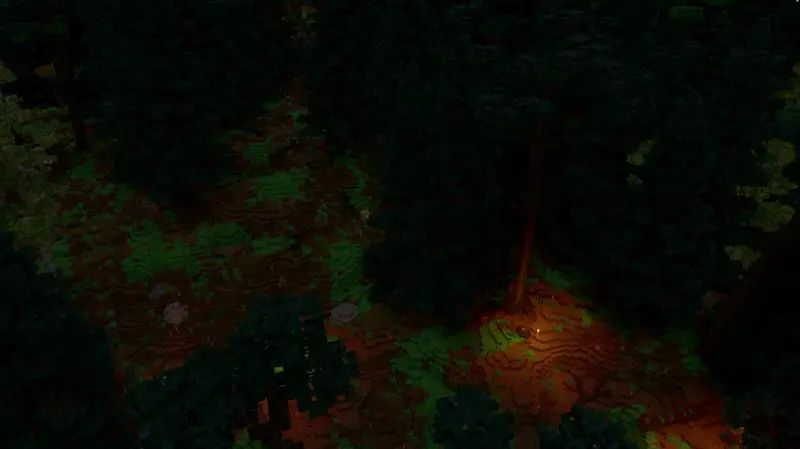
A lava lake
It breathes and lights the walls orange. A magma golem patrols its shore.Lava lights 12 m around it: you'll see it coming.
Click them
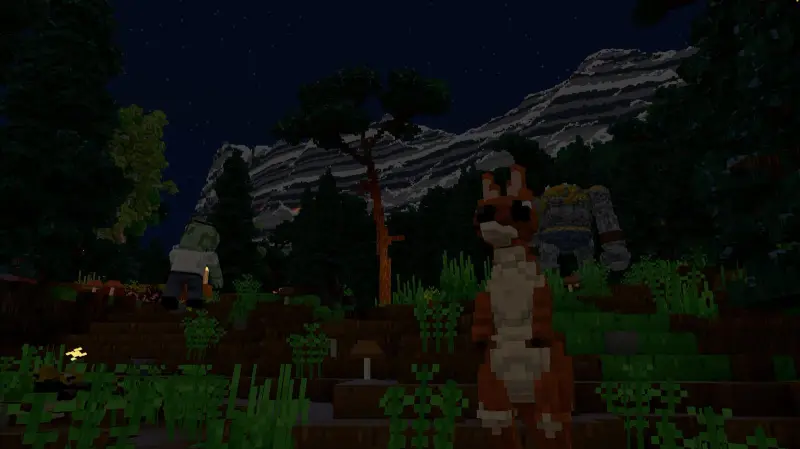
Bats, spiders, golems… and a knight holding off a troll. Hit a creature three times and it drops its bones.
A lens of oil
Black, with a rainbow sheen, trapped under shale. With a bucket, it becomes fuel — and, refined, kerosene (a real rocket propellant) and plastic.
How deep can you dig?
Heights in Openworld are real altitudes: the sea sits at 160 m and the peaks climb up to 300 m. The floor of the world is the bedrock, at altitude 0 — that is 160 m under the beach, and up to 300 m under a summit. Caves live in the 200 m band under the surface, never in the bedrock.
And the center of the planet? It's 1,000 km further down: out of reach. Since the world is a round planet, “down” always points to that center, wherever you dig — at the equator as at the poles.
Ores by depth: where to find coal, iron, gold and gems
Ore lies in veins: strings of pockets in the rock. Each ore has its own depth band, and some like a particular land above them. The main ones:
- Coal: 3 to 70 m — your torches, your fuel and the Furnace's reducer.
- Copper: 8 to 90 m, more common under highlands.
- Iron: 10 to 140 m — tools, armor, buckets.
- Raisonite: rare violet pockets, 35 to 110 m — the first alloy.
- Gold: 70 to 200 m.
- Titanium: 90 to 200 m, three times as common in volcanic provinces.
- Gems: 100 to 200 m, more common under mountains. The diamond is cut out of gem ore.
- Uranium: 120 to 200 m.
Bauxite, lithium, saltpetre, sulfur and flint feed the machines too. When you need ores for your armor, you now know how far to go; all of them, with the lands they like, are in our resources guide.
- 200meters of caves under the surface
- 19kinds of ore in the veins
- 134giant lodes on the Earth
- 14meters lit by one torch
Coal and iron from your very first cave
On top of the big veins, the first 48 m under the ground hold a second, denser network of small coal and iron veins: almost one 6 m cube of rock out of two has one, so every cave wall shows some — about one vein every 25 m of gallery. A full iron armor fits in two or three iron veins. That's why your first nights go so much better with a pickaxe in hand.
Giant lodes and their boulders
Every world also hides giant lodes: about ninety on the Earth, ellipsoids of ore 40 to 120 m wide whose top lies 2 to 30 m under the ground — coal, iron, copper, bauxite, gold, titanium, lithium, uranium, gems, saltpetre and oil. The first coal, iron, copper and bauxite lodes lie between 250 and 700 m from the world's starting point, the others within 1.5 km.
How to spot one: boulders of ore, 2 to 4 m high, standing on the ground above its core. Dig into the middle: the core is pure ore, thinning out toward the rim. Oil is the exception: no boulders, but black seeps of bitumen (see below).
Lava: how not to die
Lava lakes sit deep: domed chambers whose floor is a lake of lava, rimmed with obsidian, magma rock and basalt. Their bottom lies 6 to 30 m above the bedrock, always at least 40 m under the surface. You'll find one in one 220 m stretch of land out of five — one out of two in volcanic provinces. Some flooded caves fill with lava instead of water, too, when their level is deep enough.
Lava lights 12 m around it, so its orange glow warns you from afar. Step into it and you burn, again and again, and your health melts: a few seconds is enough. Armor softens the burns, it doesn't save you. The death screen sums it up: “You tried to swim in lava.”
Oil and what it's for
Oil sleeps in two kinds of fields. Giant oil fields lie under the lowlands — plains and gentle land away from the mountains: one within 6 km of the world's start, eight more around the planet. Their sign is on the ground: three to five oil conduits climb all the way to the surface, each capped with black bitumen in a ragged patch 1 to 3 m wide. Dig through it and follow the pipe of oil down to a lens about 120 m wide, its top some 30 m under the ground.
Small lenses — 20 to 60 m wide, 6 to 16 m thick, centered 20 to 60 m down, trapped under a cap of shale — show nothing at the surface. Thin conduits climb from their roof and stop 2 to 8 m under the ground in a stain of bitumen: dig, and when your pickaxe meets bitumen or dark shale, the oil is below. In a cave, a black bitumen pillar between floor and ceiling is the same conduit: follow it down. Look under deserts, plains and plateaus; never under volcanoes or high mountains.
A little air sits on top of every lens, and bitumen can be lit with a torch: it then burns forever, a beacon over your oil. All the signs, step by step, are in our resources guide.
To bring it up, you need a bucket (three iron ingots): one cubic meter of a single liquid at a time. Then the refinery, a copper column over a fire, splits oil into:
- Kerosene, and RP-1 for real rockets once poured into a dewar;
- Petrol and diesel, fuels for your generators;
- Natural gas, liquefied into methane at the gas plant;
- Plastic (on another setting), for circuit boards, batteries and cables, and tar.
Raw oil also burns in a fuel slot (20 seconds per cubic meter). And if you dream of pumps and conveyors, see what oil is for in a factory.
Crystals, geodes and stalactites
From 20 to 160 m down, your pickaxe may break into a geode: a hollow sphere 4 to 9 m across, a calcite shell lined with glowing crystals, quartz and a few gems. Crystals give off a cold light that reaches 5 m, like the blue glowing mushrooms of lush caves: in the dark, they're your landmarks.
Stalactites hang in calcite from the ceilings of dripstone caves, in packed ice in frozen caves; in deep caves, crystal clusters take their place.
What lives down there
Underground, it's always night. Creatures of the dark come out in caves at any hour, from 6 m down to about 50 m under the surface. Who you'll meet:
- Bats (hostile): in groups of 2 to 5, they swoop down on you. They drop guano.
- Zombies, slimes and shroomers (hostile): the night's regulars, at home underground.
- Spiders (neutral): leave them alone and they leave you alone. Their string makes your bow.
- Trolls (hostile): 2.6 m tall, slow and hard-hitting. Some carry a diamond.
- Magma golems (hostile): they glow, and they're five times more likely next to lava.
- Crystal golems (neutral): huge and glowing, peaceful as long as you don't hit them.
- Fire salamanders (neutral): a cone of fire, and a fire gland for you if you win.
- Imps (hostile), scorpions (neutral) and harmless sporelings complete the cast.
- The mimic chest: a chest… that bites. Beat it for iron and gold ingots, arrows, and sometimes a diamond.
The surface has its own crowd at night: see monsters in the dark.
Light and getting back out
Far from the entrances, it's pitch black. Your light comes from what you bring: a torch (one voxel of coal on a stick makes four) lights 14 m around it, a lantern (a torch under an iron cage) gives the same reach in white — and no monster spawns in their light. Down there, only lava (12 m), crystals and glowing mushrooms (5 m) shine on their own.
- 1
Pack torches and food
Craft a good stack of torches before going down: coal shows up on the first walls, so you can refill on the way.
- 2
Mark your way
Place a torch at every fork, always on the same side as you go down: no monster spawns within 14 m of it. To come back, keep them on the other side.
- 3
Mine as you go
Coal and iron line the first tens of meters. A better pickaxe — wood, stone, iron, titanium — digs faster and lasts longer.
- 4
Watch your step
A fall hurts from 3 m, and every extra meter costs you more health. Ravines and shafts are deeper than they look in the dark.
- 5
Respect liquids
In a flooded cave you hold your breath 15 seconds, then you start to drown. Near lava, keep a voxel of rock between it and your feet.
- 6
Dig your way up
Lost? Cut stairs into the rock toward the surface. Caves never go deeper than 200 m under the ground: the sky is always within reach.
Follow Openworld
@play_openworld is Openworld's official Instagram page: videos of the game and news of every update.
@play_openworldOpenworld is created by @tompascard
Three steps and you're underground
- 1Install Openworld with the downloaded file: it sets up the launcher.
- 2Create your account in the launcher and confirm your email.
- 3Pick your username… and play.
Openworld is played on a computer: Mac, Windows or Linux. Send yourself the link, we'll be waiting on the other side.
Questions
Is there a cave exploration game with lava, oil and giant ore lodes?
Yes: Openworld, on Mac, Windows and Linux. Under its round planet, 200 m of caves with lava lakes, oil, geodes, giant lodes and creatures.
Can you dig to the center of the planet?
No. The floor of the world is the bedrock, at altitude 0: 160 m under sea level, up to 300 m under a summit. The center of the planet is 1,000 km further down.
Where do you find iron and coal?
In every cave: small coal and iron veins fill the first 48 m under the ground. Deeper, coal goes down to 70 m and iron to 140 m. Two giant coal lodes and two giant iron lodes also lie near the starting point, the first between 250 and 700 m away: look for the boulders of ore.
How do you find oil?
Giant oil fields show ragged black patches of bitumen, 1 to 3 m wide, on lowland ground; the oil conduit under each leads to the lens. Small lenses, centered 20 to 60 m down, show nothing at the surface: dig, and bitumen or dark shale means oil below. In caves, follow the black bitumen pillars.
What is oil used for?
Scoop it with a bucket and pour it into the refinery: it makes kerosene (the base of rocket RP-1), petrol, diesel, natural gas and tar, or plastic. Plastic goes into circuit boards, batteries and rocket parts. Raw oil also burns as fuel.
Are there monsters underground?
Yes. Underground it's always dark, so night creatures come out in caves at any hour: zombies, slimes, shroomers, trolls, bats, imps. Magma golems prefer the edges of lava, and a mimic chest may bite whoever opens it.
How do you light a cave?
With torches: one voxel of coal on a stick gives four, each lighting 14 m around it, and no monster spawns in their light. A lantern (a torch under an iron cage) lights as far, in white. Lava, crystals and glowing mushrooms give off light on their own.
At what depth are diamonds?
Diamonds are cut out of gem ore, found from 100 to 200 m under the surface, twice as often under mountains. Geodes (20 to 160 m) also hide a few gems among their crystals.